How to Check a Titre Foncier in Cameroon (2026)
How to check a Titre Foncier in Cameroon: 8 steps to verify land ownership with MINDCAF, check cadastral boundaries, and avoid land scams.

Buying land in Douala, Yaoundé, Buea, Limbe or elsewhere in Cameroon can be a major investment. Before paying a seller, though, you need to establish that the Titre Foncier (land title) is genuine, that the seller is authorized to sell and that the title describes the parcel you are actually buying.
Seeing an impressive-looking original or photocopy is not enough. A genuine title can be shown for the wrong parcel; a property may be subject to registered charges; or a person offering it for sale may lack the required authority.
📋 On this page (Table of Contents)
- What a Titre Foncier is
- Step 1: Request documents
- Step 2: Visit the land registry
- Step 3: Obtain ownership information
- Step 4: Investigate legal status
- Step 5: Check the Cadastre
- Step 6: Inspect the land
- Step 7: Engage a notary
- Step 8: Complete the transfer
- Online verification
- Costs and timeframes
- Land scam warning signs
- Checking from abroad
- Frequently asked questions
What Is a Titre Foncier in Cameroon?
A Titre Foncier is a registered land title issued and maintained under Cameroon’s land tenure system. It records important legal and descriptive details about land, including the owner, location, surface area and registered rights. Its governing framework includes Ordinance No. 74-1 of 6 July 1974 and Decree No. 76/165 of 27 April 1976, as amended by Decree No. 2005/481 of 16 December 2005.
The administration keeps the official land register (Livre Foncier), while the owner normally holds an official duplicate (duplicatum). An informal sale receipt or agreement does not replace the registered title and the prescribed transfer process. See the Prime Minister’s Office text of Decree No. 2005/481 ↗.
Step 1: Request the Land Title Documents
Ask the seller for readable copies of the Titre Foncier and the documents that connect the seller to the property. Obtain the title number, registered owner’s name, parcel location, surface area, cadastral plan, seller ID and any relevant inheritance, subdivision or authorization documents.
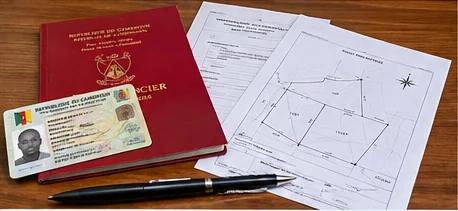
Compare the documents for discrepancies such as different spellings, inconsistent plot sizes, missing plans or alterations. If someone is acting on behalf of the owner, seek proper evidence of authority. These are preliminary checks, not proof of authenticity.
Step 2: Contact the Competent MINDCAF Land Registry
The Conservation Foncière is the relevant official land registry service under Cameroon’s Ministry of State Property, Surveys and Land Tenure (MINDCAF). The competent office depends on where the property is situated; do not assume one office verifies every title in Yaoundé or Douala.
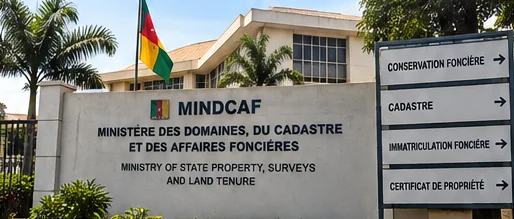
Provide the title number and request the appropriate official land-register information. Article 41 of the amended land-registration decree provides for certain certificates concerning conformity, registered entries and the absence of entries. Confirm which certificate is appropriate for the transaction with the registrar or your notary.
For administrative contacts, visit the MINDCAF website ↗ and MINDCAF contact page ↗.
Step 3: Request a Recent Certificat de Propriété
A Certificat de Propriété is an official ownership certificate obtained via the relevant land registry procedure. Follow the office’s current requirements for the application, applicable charges, payment receipt and collection. The seller may need to cooperate with the request.
Use a recently issued certificate. MINDCAF’s published paperwork for certain transaction visa files calls for a certificate less than three months old; this is not the same as a universal expiry rule for all certificates. In every case, information can change, so ask whether another updated search is appropriate close to completion.
Step 4: Confirm Ownership, Charges and Authority to Sell
Check whether the registered owner matches the person selling. If not, investigate the chain of title and any mandate, company authorization or inheritance documents. Your notary should examine mortgages, charges, restrictions and relevant entries affecting the property.
Do not assume that a certificate naming the owner also proves the absence of a mortgage, dispute or other problem. Ask for the specific official information needed to establish the property’s present legal status.
Step 5: Verify the Cadastral Plan and Plot Boundaries
The land title must describe the same parcel you intend to buy. Compare its cadastral location, area and boundaries with the site shown by the seller. A qualified survey professional can assist with boundary markers, overlaps, and conflicting plans.
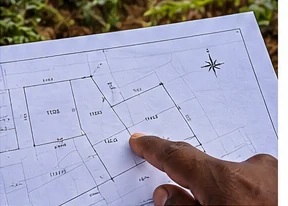
A genuine title can be misused to market another parcel. Maps on a phone and GPS pins may help with orientation, but they are not a substitute for formal cadastral verification.
Step 6: Visit the Land and Look for Disputes
Visit the site yourself or arrange an independent inspection. Look at access roads, construction activity, occupants, farming or use by other people, neighboring boundaries and any sign of competing claims. Information from neighbors may alert you to an issue, but it does not supersede official records.
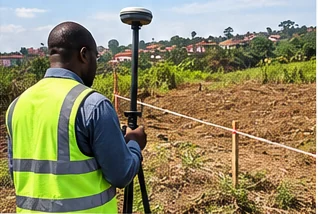
If you plan to build, check local planning rules and any applicable easements, setbacks or restrictions. For suspected litigation or conflicting claims, engage a qualified Cameroonian legal professional.
Step 7: Work With a Qualified Notary
A notary is central to formalizing many property transactions. Article 23 of the amended decree sets out documents involved in submitting a notarized deed of sale to the registrar. Your notary should confirm the legal authority of the parties, the deed, any subdivision requirements and the transfer process.

Take extra care if the owner is deceased, the property is part of an estate, a company is selling, the seller holds a power of attorney or only part of a larger titled property is offered. A portion may require morcellement (subdivision) before proper registration.
Step 8: Complete the Registered Transfer
Payment alone does not make the title legally yours. Depending on the circumstances, a transfer (mutation) or subdivision process may be required. Ask your notary to explain the required deed, cadastral records, fees and registration sequence and when the transfer has actually been completed.
Can You Check a Titre Foncier Online in Cameroon?
MINDCAF has publicized digitalization work, but the official sources reviewed for this guide did not establish a nationwide public website on which entering any land-title number is by itself sufficient to conclusively verify the title. Check the provenance of any online service before sharing personal records or paying fees. Cameroon Land Market provides guidance and property listings; this website is not the government land register.
Even if you have a preliminary digital reference, obtain the appropriate land-register information and cadastral checks before purchasing property.
How Much Does Verification Cost and How Long Does It Take?
Charges vary with the certificate requested, stamps, professional surveys, notarial work and any complications. MINDCAF has published a fee for a relevé immobilier in its FAQ, but this is not an all-inclusive fee for every title check. Confirm the current charge with the competent office and retain official receipts.
| Item | What to confirm |
|---|---|
| Registry certificate | Exact document, application requirements and official fee |
| Cadastral check | Plan, survey scope and itemized price |
| Notarial review | Due diligence and transfer formalities |
| Processing time | Current timeframe quoted by the competent office |
See MINDCAF’s FAQ and published fee information ↗. Do not trust a promised universal turnaround time or an intermediary demanding unofficial payment.
Seven Warning Signs of a Potential Land Scam
- The seller refuses to let you check the title at the land registry.
- The number cannot be reconciled with official records.
- The owner’s identity does not match and authority to sell is unexplained.
- The seller insists on immediate or untraceable payment.
- The plan and physical boundaries do not agree.
- Several people claim ownership or occupation of the same parcel.
- The only evidence offered is an informal agreement or handwritten receipt.
Any of these is a reason to investigate further, not an automatic finding of fraud.
How to Check a Titre Foncier From Abroad
If you live outside Cameroon, appoint an independent Cameroonian lawyer or notary and, when appropriate, a survey professional. Request written reporting, recent registry documentation, site photos, precise parcel identification and traceable records of payments. If granting a power of attorney, limit its authority to what is necessary and obtain legal advice about proper authentication.
Your Pre-Purchase Verification Checklist
- ☑Collect the seller’s title number, copy and identification.
- ☑Find the competent Conservation Foncière.
- ☑Request recent official ownership information.
- ☑Investigate registered rights, charges and restrictions.
- ☑Confirm the seller’s legal authority to sell.
- ☑Compare the cadastral plan to the physical property.
- ☑Inspect the plot and investigate possible competing claims.
- ☑Engage a notary to oversee the proper transfer.
- ☑Retain receipts and the final registered documents.
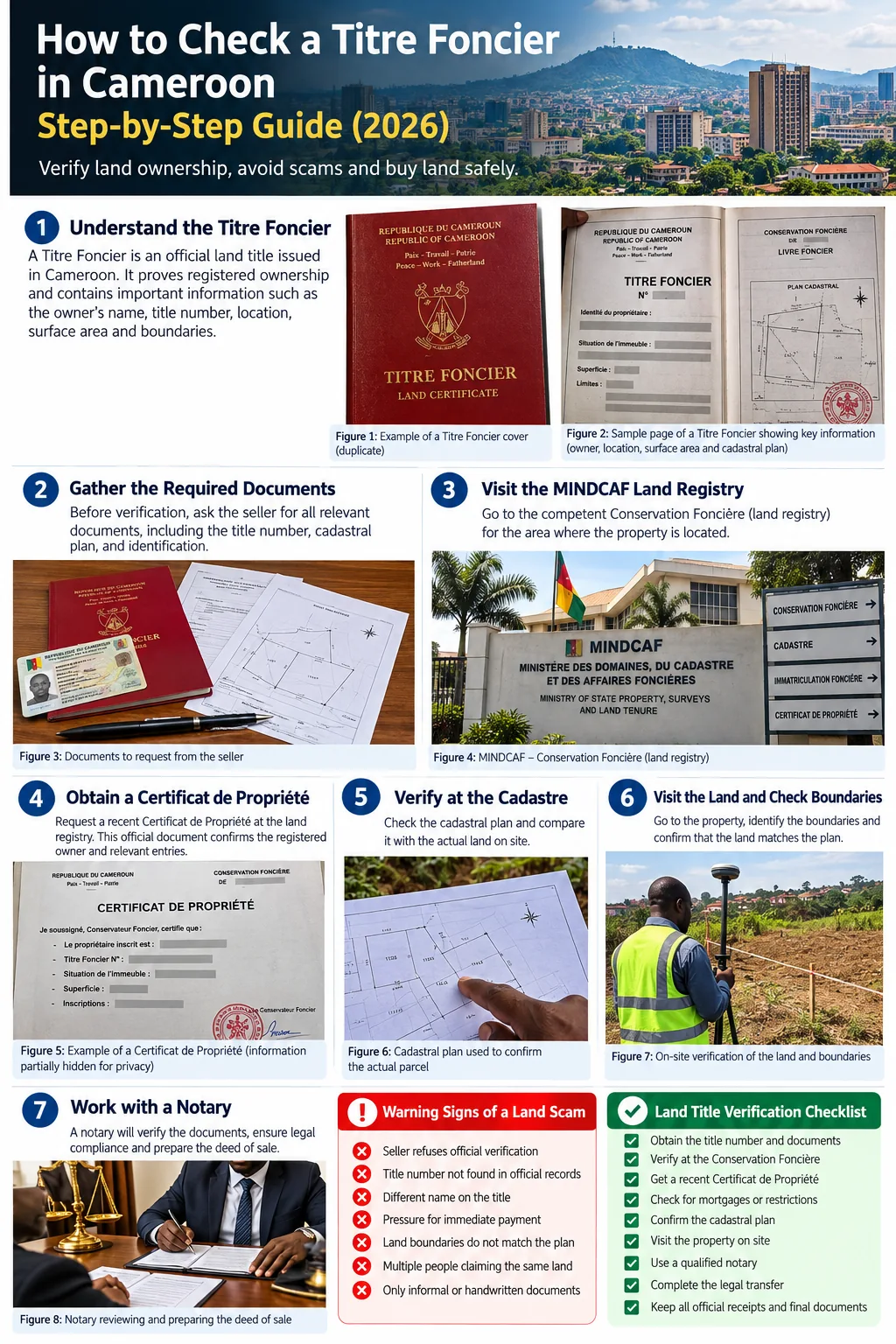
🔍 Open the full illustrated verification infographic checklist
This graphic uses invented example documents and scenes. It is an editorial illustration—not a government form.
Frequently Asked Questions
How do I know if a Titre Foncier is genuine?
Request official verification through the competent Conservation Foncière, compare the land register with the seller’s documentation, and confirm the corresponding parcel through cadastral checks.
Can I check a land title using only the Titre Foncier number?
The number is a useful starting point, but it cannot by itself establish present ownership, authority to sell, absence of charges, or that you have been shown the correct parcel.
What office verifies Titre Foncier in Cameroon?
The competent Conservation Foncière under MINDCAF keeps the land register. Cadastral services help verify the technical description, plan, and boundaries.
Can I check a Titre Foncier online?
Do not assume that a publicly accessible online result conclusively authenticates every Cameroonian title. Confirm any digital service is official and obtain appropriate registry verification.
Is a Certificat de Propriété enough to buy land?
No. It is useful evidence of recorded ownership information, but you should also check registered charges, the seller’s legal authority, the parcel, and the transfer requirements with a notary.
How long should verification take?
Timelines depend on the registry, the requested document, and whether legal or cadastral complications arise. Ask the relevant office for its current processing time.
Can a valid Titre Foncier be cancelled?
Cameroonian law contains defined grounds and procedures concerning withdrawal or nullity of land titles. A seemingly authentic document is not a substitute for legal due diligence.
How can someone abroad check a land title?
Use an independent Cameroonian notary or lawyer and a qualified surveyor. Ask for written verification, copies of official certificates, and traceable records of all payments.